The Frontier Everyone Can See and No One Can Measure
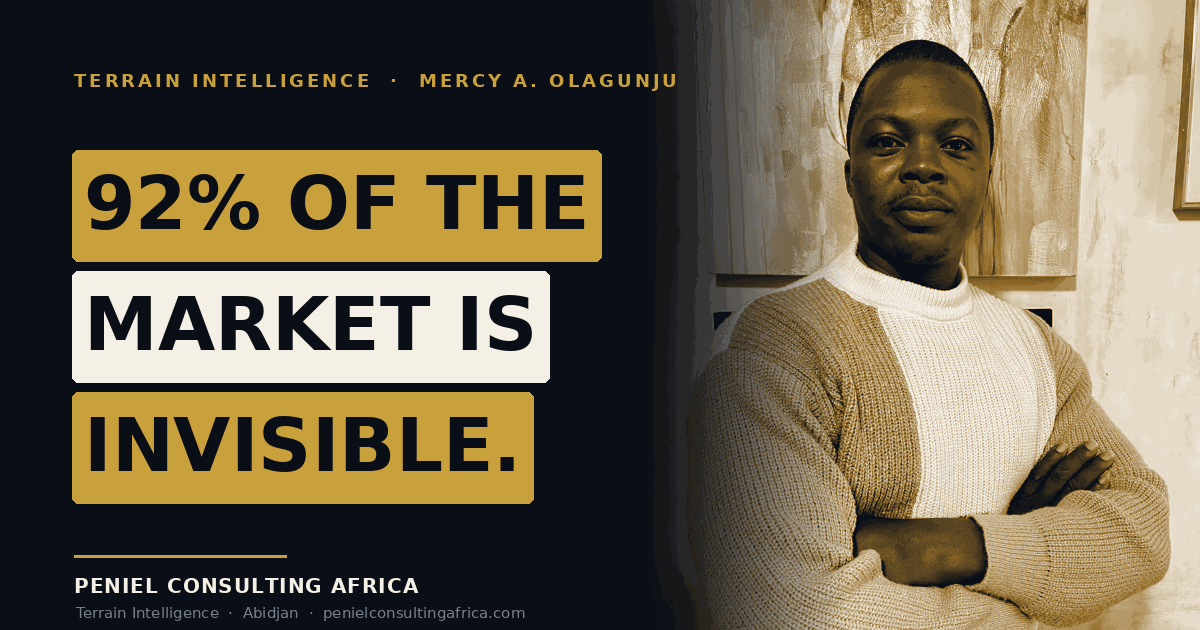
- Across Sub-Saharan Africa, ~85% of employment is informal; in West & Central Africa it reaches ~92% — the highest on the continent (ILO).
- Nigeria's informal economy is worth 57–65% of GDP (IMF). In the WAEMU zone the share is higher and less measured.
- The opportunity is bigger here — and less legible. That gap is the point.
A sharp piece this week from Dr Aremu Fakunle John made the case for Nigeria's informal economy as the continent's biggest untapped investment frontier. He's right. This is the other half of the map — the one told in CFA francs, OHADA, and the WAEMU trade corridor.
Because if the informal economy is the frontier, Francophone West Africa is its most extreme expression — and its least legible.
The numbers, where they exist
Start with what can be measured. Across Sub-Saharan Africa, roughly 85% of all employment is informal (ILO). In West and Central Africa specifically, that figure climbs to around 92% — the highest on the continent. Nigeria, the reference case, runs an informal economy worth 57–65% of GDP.
Now cross into the WAEMU zone, and something telling happens: the numbers get bigger and blurrier at the same time. Senegal's informal sector generates more than half the country's output. Côte d’Ivoire's informal workforce is vast — and precisely uncounted, with estimates that swing depending on who's measuring. Nigeria at least has a statistics bureau and repeated IMF estimates. In much of Francophone Africa, the informal economy is both the majority of the market and the part no dataset captures cleanly.
The measurement paradox is the whole point
Here is what a desk in Paris or Lagos misreads. The instinct is to treat the informal economy's invisibility as risk — the thing you hedge around until it formalises. In the WAEMU zone, that instinct loses you the market. The informal layer is not a fringe around the real economy; here it very nearly is the economy. When 90% of employment and more than half of output live outside the formal ledger, the market you can measure is a rounding error on the market that decides whether you win.
And it cannot be sized from a distance. It has to be walked — the phone-vendor points, the Dioula corridors that move goods across three borders without a single ratified document, the household demand no survey reaches. The data doesn't exist. The terrain does.
Why this matters right now
This is the sequel to a story I wrote days ago. Côte d’Ivoire just adopted a national plan — the PND 2026–2030 — that stakes 70% of a roughly $200 billion programme on private capital. Sit that fact next to this one: that private capital has to land in an economy where the clear majority of transactions never touch a formal ledger.
The investment frontier and the informal economy are the same place. A national plan can announce that private money is welcome; it cannot make the informal market legible to a firm that arrives with a formal-sector playbook. Whoever can read the informal layer — who actually moves the goods, who actually pays, where demand actually sits — captures the frontier. Whoever waits for the survey misses it, because the survey is not coming.
What it means for your company
If you're an investor or fund: the informal economy is not the risk to hedge around — in the WAEMU zone it is the market. Size your thesis to the 70–90% that's informal, not the 10–30% your model can see, or you've mis-sized the opportunity by an order of magnitude.
If you're a firm entering: your go-to-market has to be built for informal distribution, informal payment, and informal demand from day one — not bolted on after a "formal" launch stalls. The distributor from the slide deck sells to the market that can be measured; the market that decides sales is the other one.
For everyone: the frontier is real and the ambition is right. But the gap between the opportunity on paper and the terrain on the ground is exactly where entries succeed or fail — and it is the one thing that has to be verified in person, not modelled from abroad.
Reading the informal market before you commit capital to it?
That's what a Terrain Audit is for. Book a 20-minute Terrain Briefing — bring one specific market question, leave knowing what it costs to get it right versus wrong.
Book a Terrain BriefingWith credit to Dr Aremu Fakunle John, whose piece on Nigeria's informal economy prompted this Francophone companion.
- ILO — Sub-Saharan Africa ~85% informal employment; West & Central Africa ~92% (regional statistical profiles / ILOSTAT).
- IMF — Nigeria's informal economy up to ~65% of GDP.
- World Bank / IMF — Senegal informal sector generating more than half of national output.
- Côte d’Ivoire informal workforce: large but variably estimated — the variance is itself the point.