Côte d’Ivoire’s PND 2026–2030: What a 70%-Private Development Plan Actually Means for Your Entry
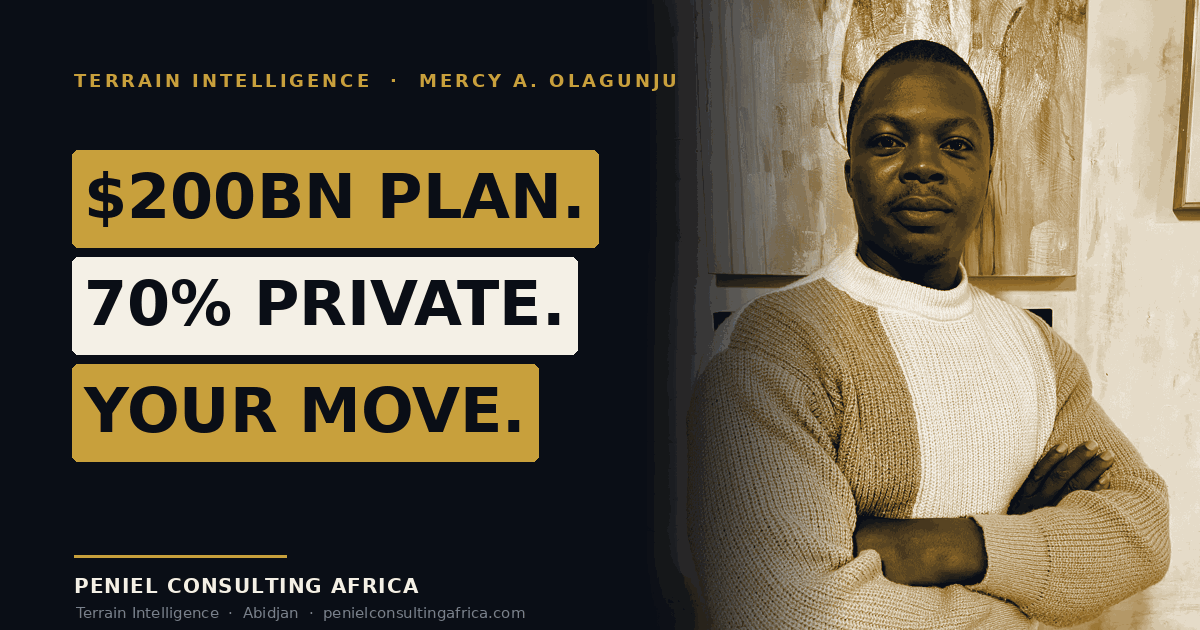
- Côte d’Ivoire has adopted its Plan National de Développement (PND) 2026–2030, worth 114,838.5 billion FCFA — roughly $200 billion.
- 70.2% of it — 80,614.7 billion FCFA — is expected from the private sector; only 29.8% from the state.
- This month’s Consultative Group in Abidjan (8–9 July) sought 11,138 billion FCFA in external financing and drew 47,820 billion in intentions — more than four times the target.
A government just published a five-year plan and told the market it will not pay for seventy percent of it. Most firms will read that as a number. It is a signal — and a test of exactly the terrain most of them misread.
What was actually decided
The PND 2026–2030, adopted unanimously by the National Assembly and the Senate, carries a global envelope of 114,838.5 billion FCFA (about $200 billion). The headline that matters is not the size — it is the split. 70.2% (80,614.7 billion FCFA) is meant to come from private capital, against 29.8% from the public purse. The plan rests on six priorities: peace and security, agriculture and agro-industry, the development of private investment, human capital, strategic infrastructure, and good governance. Its targets are explicit — annual growth of 7.2%, GDP per capita of $4,500 by 2030 (from $3,148 in 2025), and poverty below 20%.
To finance it, Abidjan is deliberately leaning away from aid. At the Consultative Group on 8–9 July, the government sought just 11,138 billion FCFA in external financing — under 10% of the total — and reported 47,820 billion FCFA in financing intentions already captured. National resources and private investment are expected to carry the other 90%.
The shift nobody is pricing
The important word in this plan is not “billion.” It is “private.” Côte d’Ivoire is moving, out loud, from a logic of development aid to a logic of investment partnership. When a state stakes 70% of its own plan on capital it does not control, it is not offering a handout — it is issuing a demand signal to the market and betting its growth on the market answering.
For a firm looking at the region, that changes the political weather. In the six priority sectors, you are no longer pushing against a state that tolerates foreign capital; you are pushing with a state that has publicly made private capital the engine of its plan. That is tailwind — PPP appetite, sector incentives, and ministerial attention pointed in your direction. The ratings back the story: the IMF and World Bank reclassified the country as low risk of debt distress in June, and Fitch moved it to BB (stable), in line with Moody’s and S&P. Capital and attention are flowing to Abidjan right now.
Where the tailwind actually blows
The six pillars are not decoration — they are a map of where the incentives and the political will are concentrated. Agri-industry, strategic infrastructure, digital, and human capital are where the plan wants private money. If your business sits in one of those, the plan is, in effect, a government-issued invitation, and your positioning should speak the plan’s language. If it does not, the plan still reshapes your context — the capital, the partners, and the competitor set around you are all about to move — but it does not change your operational checklist.
The caution the brochure won’t print
Here is the part that separates a plan from a reality. 80,614 billion FCFA in private financing is an intention, not an execution. That number only becomes real if the terrain can absorb it — and this is precisely the gap this practice exists to map. The plan does not shorten the CEPICI backlog. It does not sequence your OHADA filings for you. It does not build the relationships that decide whether a partnership closes. The oversubscription at the Consultative Group is real, but it is largely development-partner and institutional money; the far larger private number depends on thousands of individual firms finding the ground navigable enough to commit.
The plan, in other words, raises the prize and the competition at the same time. More capital chasing the same priority sectors means the introduction, the ministry window, and the relationship architecture matter more now, not less. The desire is being announced from the top. Whether it converts to demand at the point of execution is decided on the ground — where it always is.
What it means for your company
If you’re in a PND priority sector (agri-industry, infrastructure, digital, human capital, health): there is genuine political tailwind and PPP appetite. Position now — align your pitch to the plan’s language and move before the capital crowds in. The window is 2026, not 2028.
If you’re in fintech, payments, or SaaS: the plan leans on private investment and digital, and the financing architecture is opening — but BCEAO and CEPICI still decide your real timeline. Plan or no plan, the sequence is what gets you operational.
For everyone: a 70.2% private target is an invitation, not a guarantee of ease. It does not shorten your OHADA timeline or build your relationships. Treat it as a reason to verify the terrain before you commit capital — because the state just made the terrain the deciding variable.
Planning an entry into Côte d’Ivoire while this window is open?
Book a 20-minute Terrain Briefing. Bring one specific market question; leave knowing what it costs to get it right versus wrong.
Book a Terrain Briefing- Gouv.ci — official government portal (adoption; 114,838.5 bn FCFA; 70.2% private / 29.8% public).
- AIP — Agence Ivoirienne de Presse (state agency): 114,828.5 bn FCFA, 70% private.
- Primature.ci — PND summary (primary document).
- Agence Ecofin — $206 bn global investment framing.
- KOACI — Consultative Group, 8–9 July 2026; 11,138.2 bn FCFA sought; 47,820 bn in intentions; ratings and macro context.