Why Well-Capitalised Firms Fail in Francophone Africa Within 18 Months
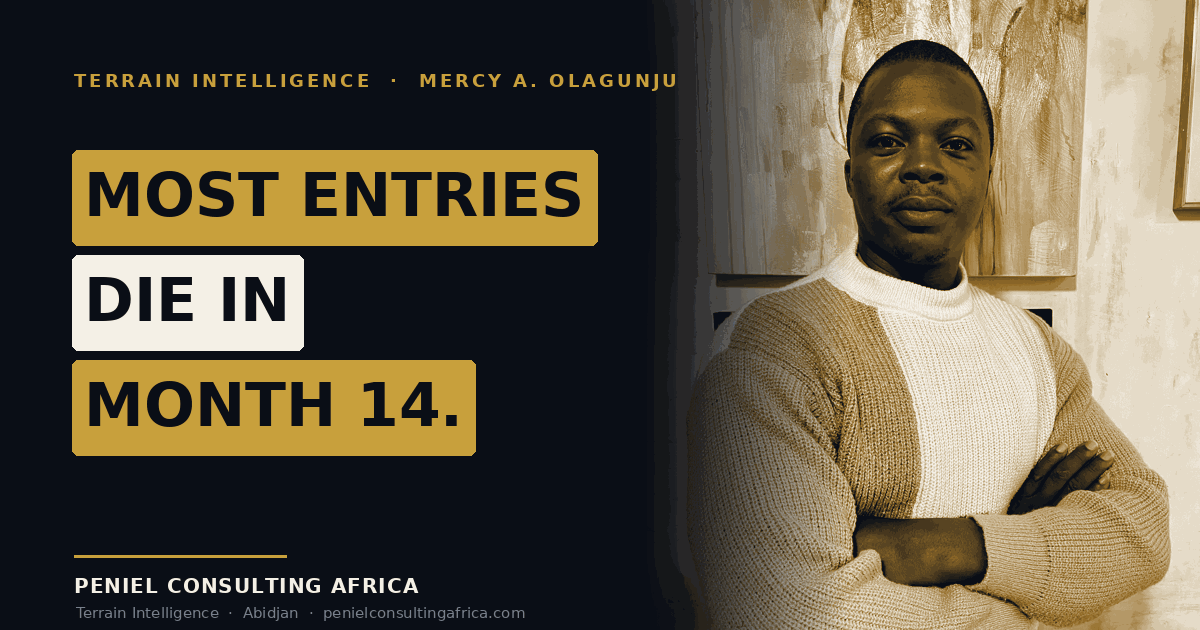
A market entry into Francophone Africa rarely dies at launch. It starts dying around month 14 — quietly, in ways the report you paid for never mentioned. By month 18, the write-off is on the balance sheet.
This is not a rare outcome. Most well-capitalised entries into the region fail inside 18 months, and the pattern is consistent enough to be diagnostic. In February 2026, Jumia — pan-African, listed, well-funded — walked out of Algeria after 14 years. Glovo left Ghana citing the sentence every exit uses: profitability “would require substantial investment over a prolonged period.” Translation: they did not know the terrain until the terrain sent the bill.
When you run the autopsy on these entries, the cause of death is almost always one of three findings. None of them appears in a standard market report.
1. The official timeline and the real timeline are different documents
The licence that “takes 90 days” takes 14 months. Not because of corruption — because of knowledge. Two companies can file the same application, under the same OHADA framework, with the same forms, and see one approved in six weeks and the other wait two years. The difference is sequencing: which dependency must clear first, the current backlog at the one-stop shop (in Côte d’Ivoire, the CEPICI), and the weeks a department is quietly understaffed.
Regulation here also moves faster than any desk can track. When the BCEAO shifted a “mandatory” deadline for its regional payment platform with five days’ notice, operators on the ground had priced the extension in for months. Anyone building a compliance roadmap from abroad had built it to a date that no longer existed.
2. The distribution partner was chosen from a desk
Who distributes your product in Abidjan is not who distributes it in Bouaké, and neither is the partner your logistics consultant in Paris will recommend. Across most of Francophone Africa, the networks that actually move goods — the informal trade corridors that cross three borders without a single ratified document — operate on a logic no formal org chart captures.
Firms that pick a distributor from a slide deck discover, around month 12, that the product never reached the shelves that matter. The formal distribution architecture looked complete on paper. The market it was built for was the one that could be measured, not the one that decides sales.
3. The relationships started after the launch — which means too late
Here, the relationship precedes the transaction. Always. The two-hour lunch where the first ninety minutes cover everything except business — those ninety minutes are the business. Firms that treat this as overhead keep losing significant partnerships to competitors with inferior products who invested in relationships first.
Timing compounds the cost. When a new minister takes office, there is roughly a six-week window to be met as a person rather than processed as a file. That window appears in no market study, and it has decided more entries than any tariff schedule.
The deeper problem: the market you can measure is not the market that decides
Underneath all three failure modes sits one structural fact: 70–80% of economic activity across most of Francophone Africa is informal. Consumer surveys capture the formal layer. Census data is years stale. Market-sizing models exclude the majority of actual transactions. The result is a confident plan built on the minority of the market that happens to be visible.
And “Francophone Africa” is not one market. Abidjan is not Dakar; neither behaves like Bamako. The informal layer is organised differently in each — which is precisely why it cannot be modelled from a distance.
What to do instead: verify the terrain before you commit
The alternative is not more desk research. It is a ground-level investigation of the specific entry you are planning — the real regulatory timelines, the relationship map that decides partnerships, and consumer behaviour measured where it actually happens. Thirty conversations on the ground beat €50,000 of desk research, every time.
That is what a Terrain Audit is: verified terrain facts before capital is committed, replacing the assumptions that quietly kill entries in month 14. The cost of knowing rounds to zero against the average cost of a blind entry that fails.
Planning an entry — or bleeding in one?
Book a 20-minute Terrain Briefing. Bring one specific market question; leave knowing what it costs to get it right versus wrong.
Book a Terrain Briefing