The Market Forgets a Price. It Never Forgets How You Made It Feel.
A price war is the easiest fight to start in this market. It is also the one you cannot win. Cut deep enough and someone will always cut deeper — usually someone with less to lose than you.
The customer remembers something else entirely. She remembers whether she was respected at the point of sale. She remembers who handed her the product, and whether that person was a voice she already trusts. She forgets the exact figure she paid long before she forgets how the transaction made her feel.
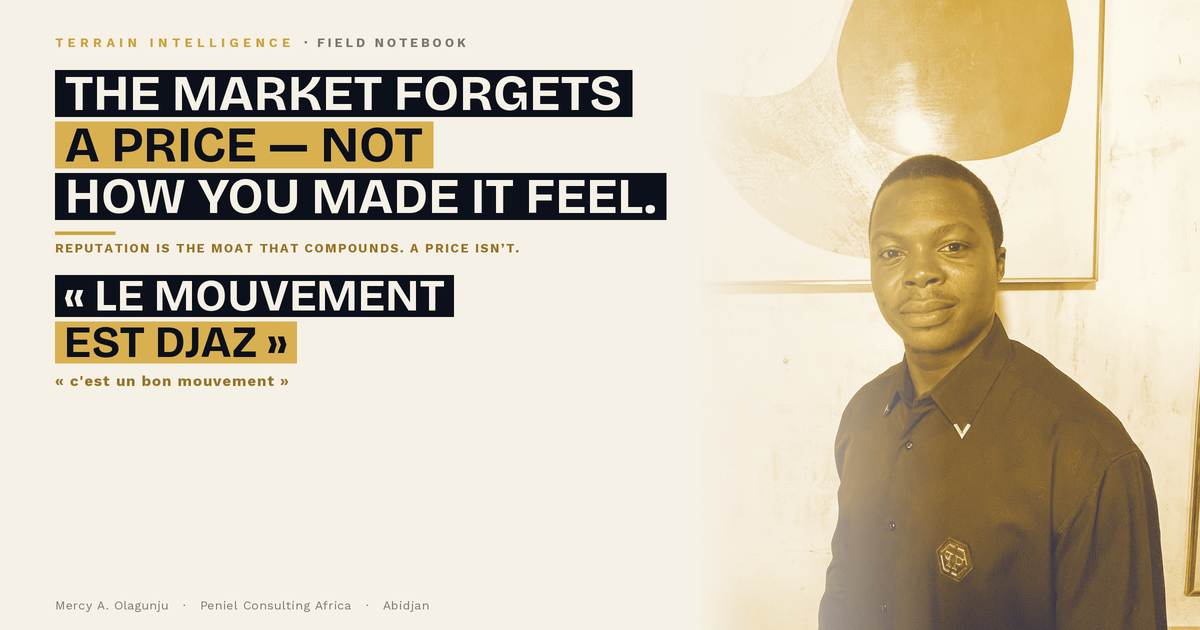
The market forgets a price. It never forgets how you made it feel.
Reputation is the moat that compounds
In a market where roughly 70–80% of economic activity is informal — and, by the ILO's 2024 estimate, around 92% of jobs are informal employment — the decisive channel is not the billboard or the supermarket shelf. It is word of mouth, moving through the marché, the boutique de quartier, the WhatsApp group. That channel does not respond to a discount. It responds to trust, and trust compounds: every satisfied buyer becomes a distributor you did not pay for.
(Informality figures: ILO modelled estimates, Africa regional statistical profile, 2024.)
This is why a defensive price cut so often fails here. Wave did not reprice the WAEMU payments market only by charging near-zero fees; it repriced the experience, and it did it through the agent network the market already trusted — going through the relationship, not around it. The lesson is not "be cheap." It is "be trusted, then be handed to the next buyer."
Local beats famous, on the ground
The instinct of a brand entering this market is to reach for the continental megastar — a Davido. There is a place for that; it buys reach. But the face that actually moves a market is usually the local one, singing in the language of the street.
Ask where the trust sits and the answer comes back fast. In Mali: Haïdara for faith, Sidiki Diabaté for youth. In Côte d'Ivoire: Didi B, Himra. Not because they are the biggest names on the continent, but because the market already believes them, in its own language. Reach gets you seen. Trust gets you bought — and trust, here, is local before it is famous.
The five words that move a market
Underneath all of it sits the smallest, most powerful unit of distribution in Francophone Africa. Not a campaign. Five words, said by the right person:
« J'ai testé ça, c'est djaz ! »
I tried it — it's the real deal. (Djaz is Abidjan for excellent — the word a buyer uses once the thing has proven itself, the way a customer tastes the garri before she confirms it's good stuff.) Said by a neighbour, a shopkeeper, a voice the market already trusts, those five words do what no media budget will. The market buys what a trusted voice hands it. Your job is not to shout louder than that voice. It is to earn your way into it.
What this means before you spend
Before the discount, before the billboard, ask a different question: who does my buyer already trust, and how do I earn the right to be handed over by them? Build the reputation and the local-voice relationships before you need the sale. By the time you are competing on price, the market has already decided how it feels about you — and that feeling, not the figure, is what it will remember.
Sources
-
Informal economy — ILO modelled estimates, Africa regional statistical profile, 2024 (West Africa ≈ 91.8% informal employment; informal share of activity ≈ 70–80%).
-
Field observation — Peniel Consulting Africa, Côte d'Ivoire and Mali, 2026.
Planning an entry — or bleeding in one?
Book a 20-minute Terrain Briefing. Bring one specific market question; leave knowing what it costs to get it right versus wrong.
Book a Terrain Briefing