The Bean Won't Leave Naked Anymore — Inside the Four-Nation Cocoa Alliance
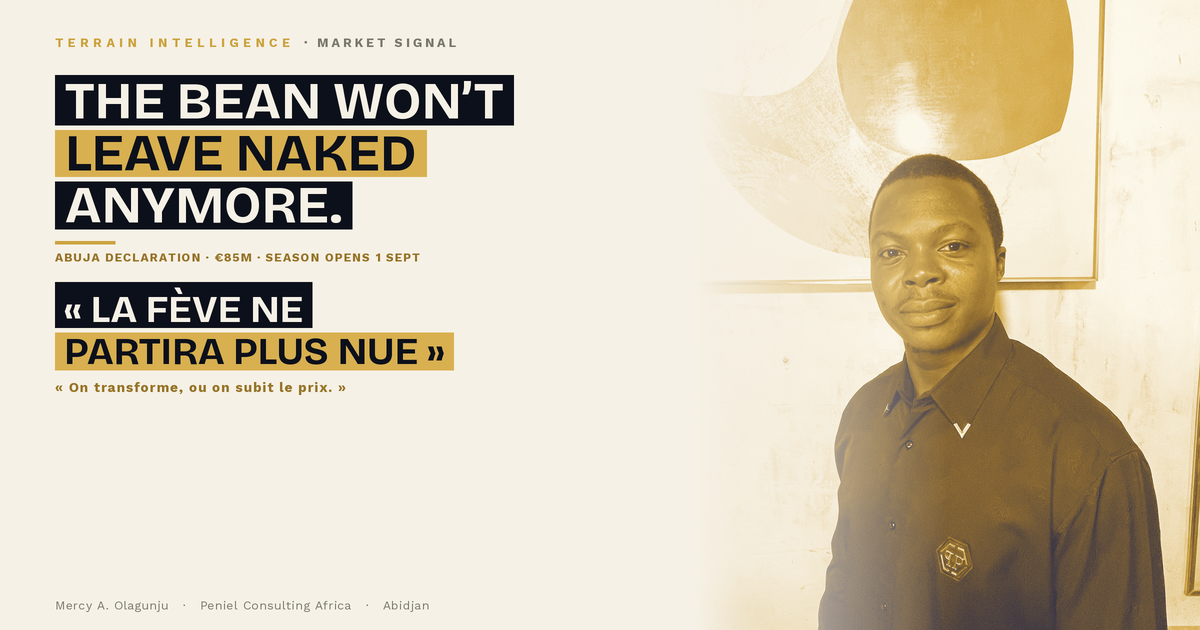
Africa grows most of the world's cocoa and keeps a fraction of its value. That is not a fatality. It is a model — and in July 2026, four states decided to change the equation.
On 1 September, Côte d'Ivoire and Ghana open the 2026/27 cocoa season, a month earlier than the traditional October start. They open it as different players than they were a year ago. In mid-July, at a value-addition summit in Abuja, Côte d'Ivoire, Ghana, Nigeria and Cameroon signed the Abuja Declaration — a commitment, backed by an €85 million facility, to stop exporting the bean naked and build the processing and branding that keeps the value at home.
Why this one is different
For decades, Africa's cocoa story was the same: grow the bean, ship it raw, watch it become a $130-billion chocolate market somewhere else. The four signatories together grow roughly 70% of the world's cocoa — and until now they competed at the bottom of the chain, each undercutting the other on price. The Declaration is the first credible attempt to move up the chain together: local grinding into butter, mass and powder; coordinated positions in front of buyers and regulators; common standards.
It is a political and industrial framework, not a price office. It does not set a farmgate price or restrict supply. What it does is rarer — it aligns the producers who have never aligned.
Three clocks are running
The season opens 1 September. Côte d'Ivoire and Ghana moved the 2026/27 opening forward from October; the guaranteed farmgate price for the new marketing year is set at the start.
The EUDR clock hits 30 December. The EU's deforestation regulation requires every bean entering Europe to be traceable to the individual farm — for large and medium operators — from 30 December 2026. Faced alone, that traceability is a heavy, expensive burden. Faced as a bloc, with shared systems and standards, it becomes leverage.
And the market itself is impatient. The price swings of recent seasons reminded producers how completely they are subject to a price decided elsewhere. Value addition is the one lever that changes who sets it.
What it means for anyone in cocoa
If you source, finance or build in cocoa, the map just moved. A bloc that processes negotiates differently from a set of countries that only export. The premium, the traceability compliance, the grinding capacity — these begin to be decided together now, not one ministry at a time.
But read the terrain before you re-price your assumptions. Alliances here are easy to announce and hard to keep; €85 million is a start, not the industrial base a real processing shift requires; and moving grinding onshore takes power, ports and years, not a declaration. The signal is real. The delivery is unproven.
The honest read: this is not a price story, it is a value story — the first time the continent's biggest producers have tried to climb the chain together instead of undercutting each other at the bottom of it. Whether it holds is the question the next 120 days — from the 1 September opening to the 30 December EUDR deadline — will begin to answer.
Sources
- 2026/27 cocoa season opens 1 September (Côte d'Ivoire + Ghana, moved from 1 October) — CNBC Africa, 2026.
- Abuja Declaration signed mid-July 2026 (Côte d'Ivoire, Ghana, Nigeria, Cameroon); €85M facility; aim to end raw-bean exports — TheCable, Financial Afrik, BusinessDay (July 2026).
- EUDR traceability for large and medium operators from 30 December 2026 — EU regulation; summit coverage.
- Global chocolate market over $130 billion; the four grow around 70–75% of world cocoa — Abuja summit coverage (2026).
Planning an entry — or bleeding in one?
Book a 20-minute Terrain Briefing. Bring one specific market question; leave knowing what it costs to get it right versus wrong.
Book a Terrain Briefing